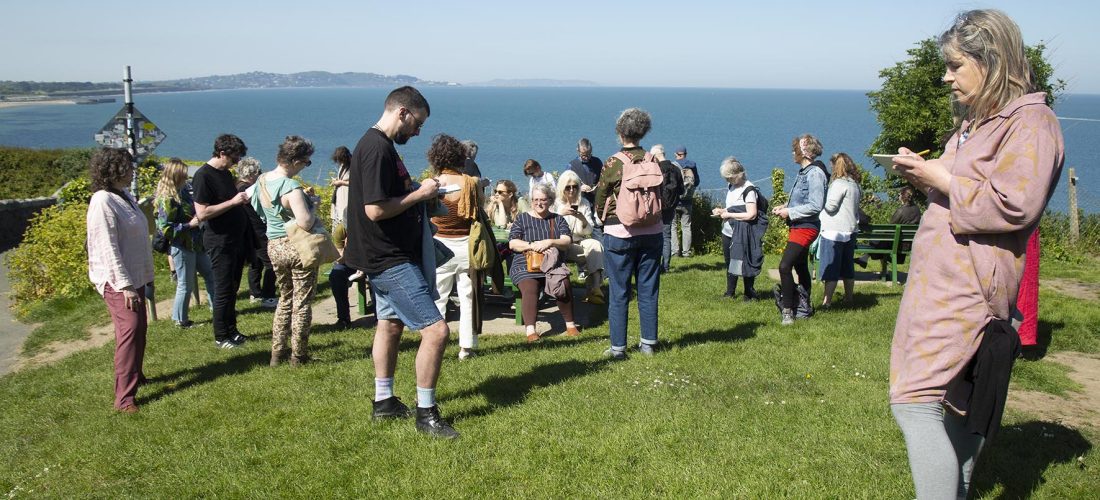
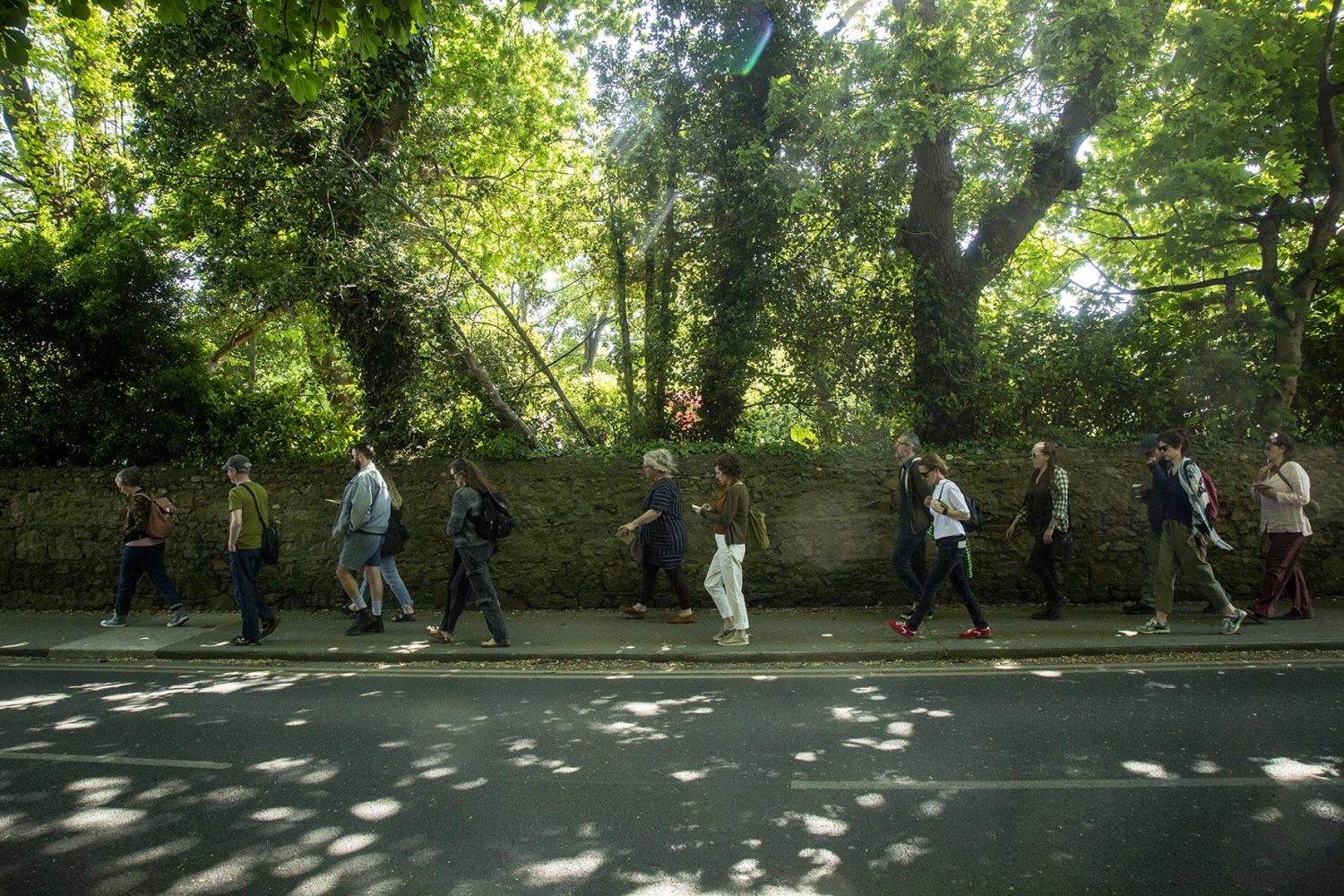
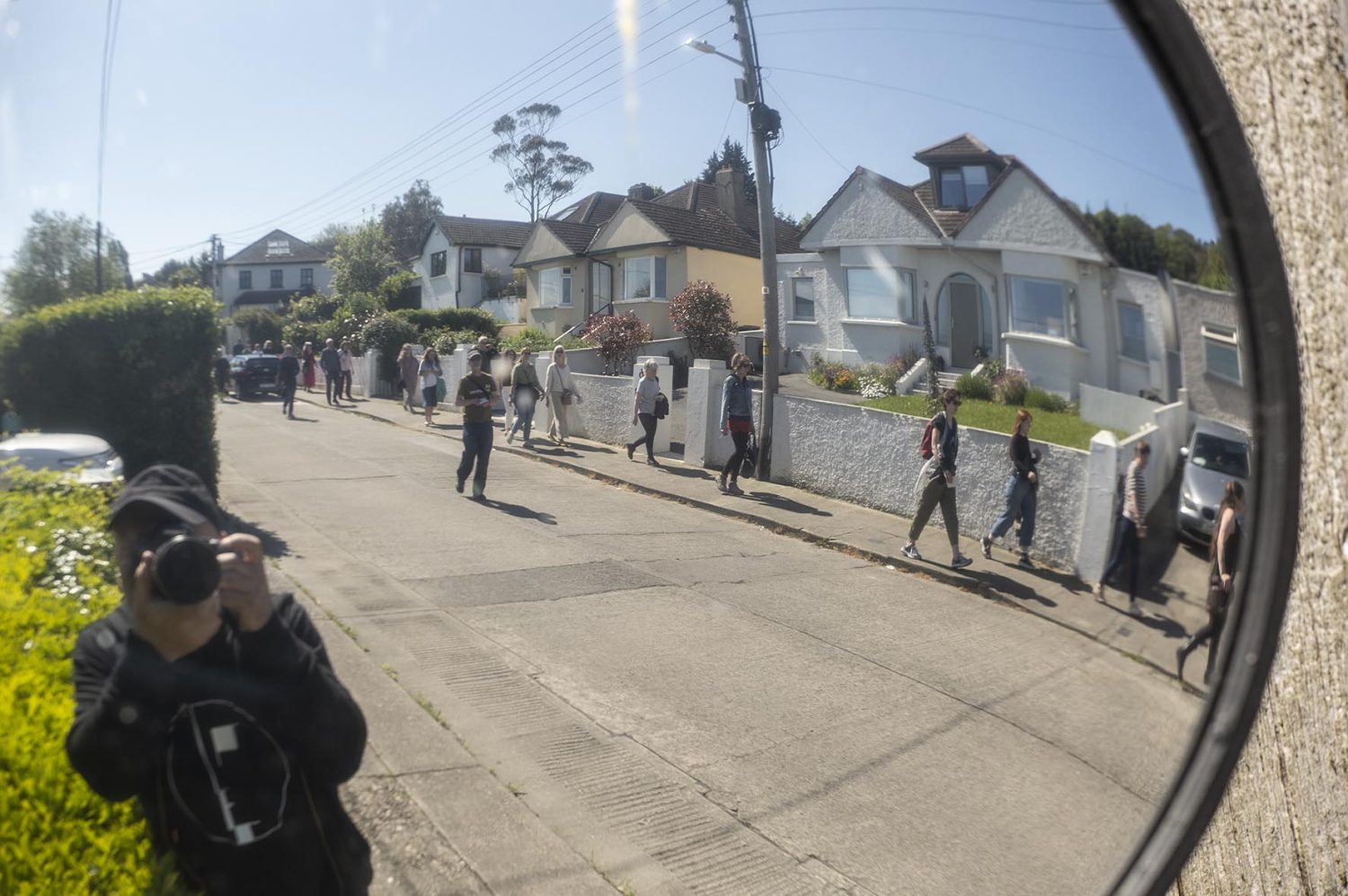
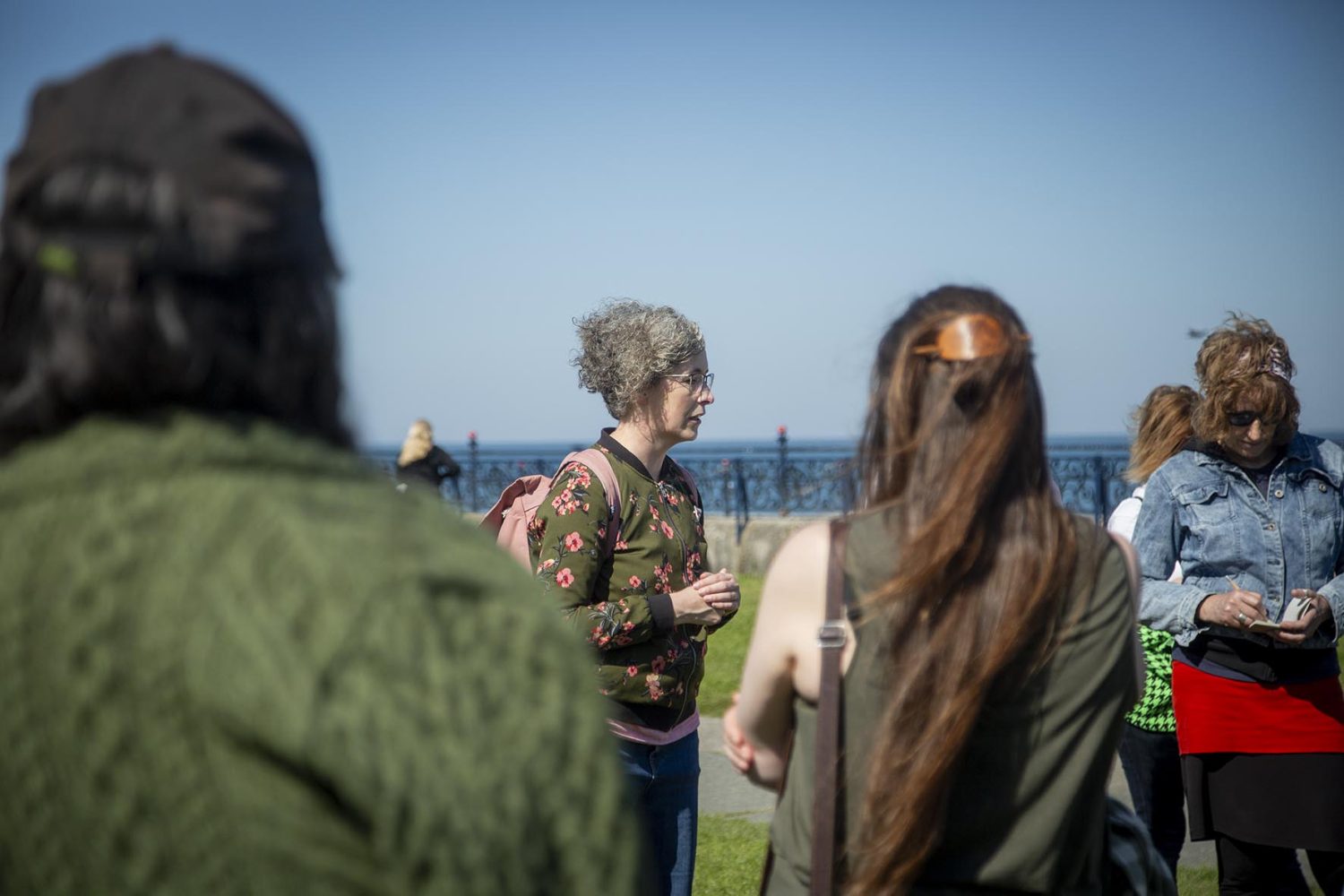
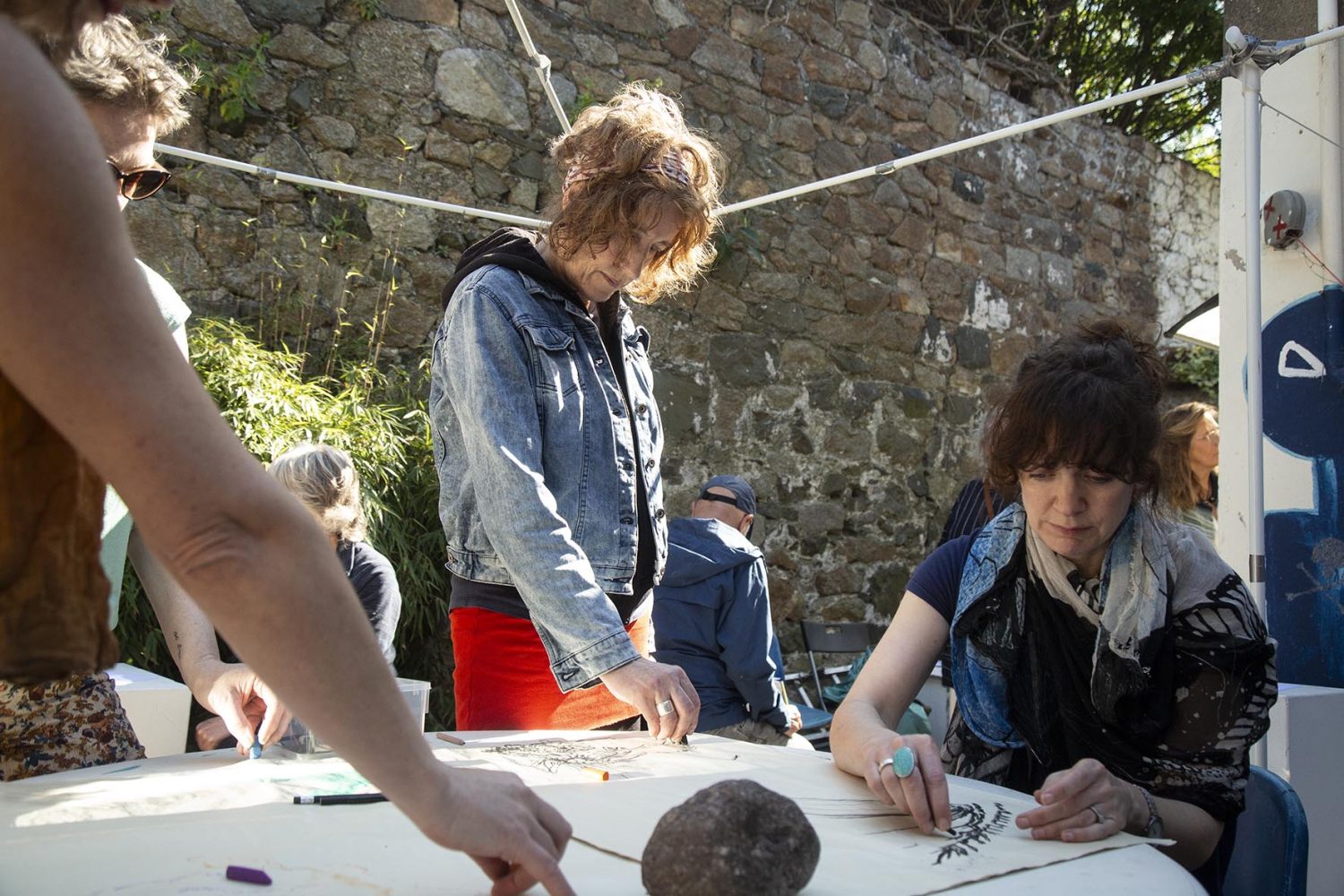
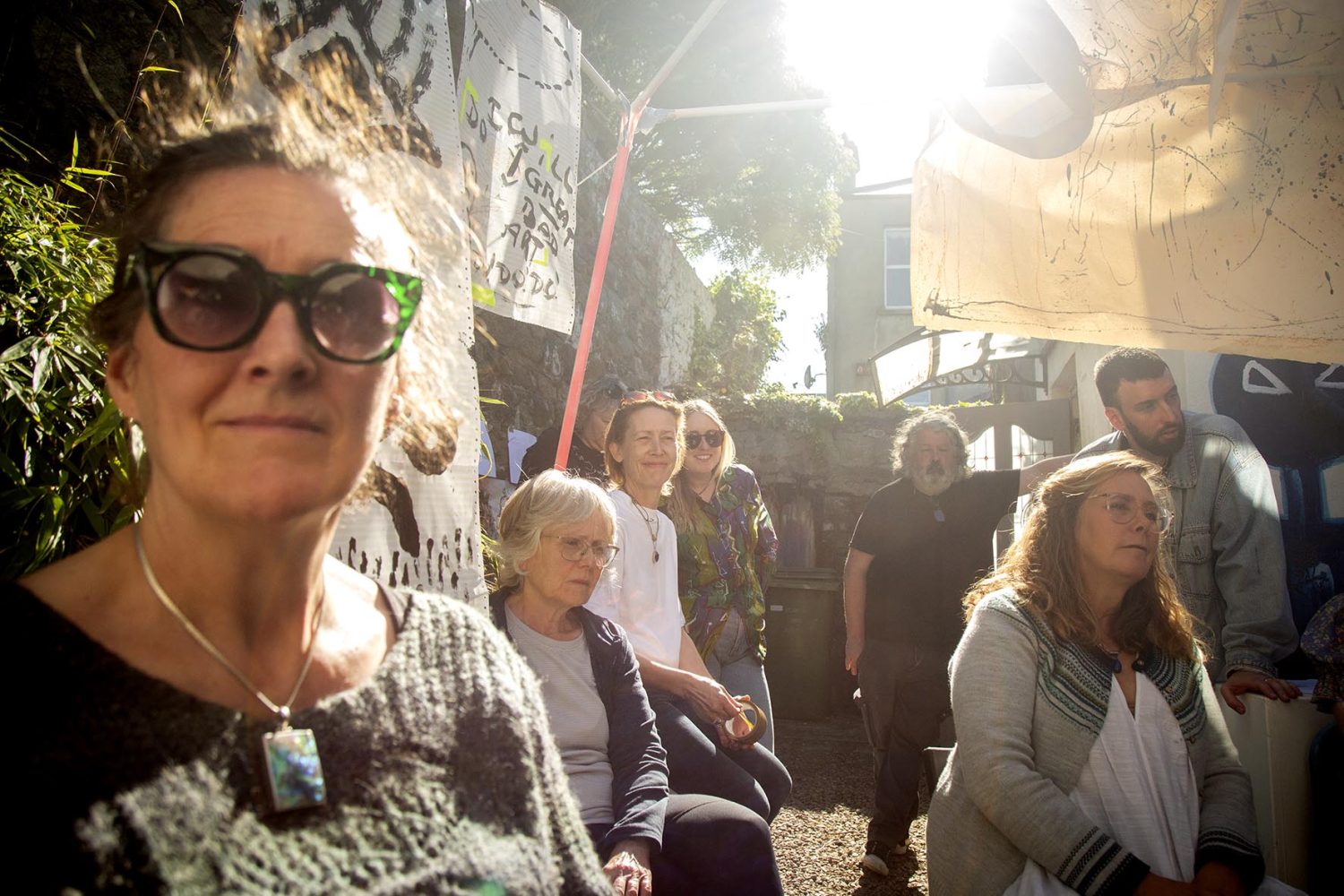
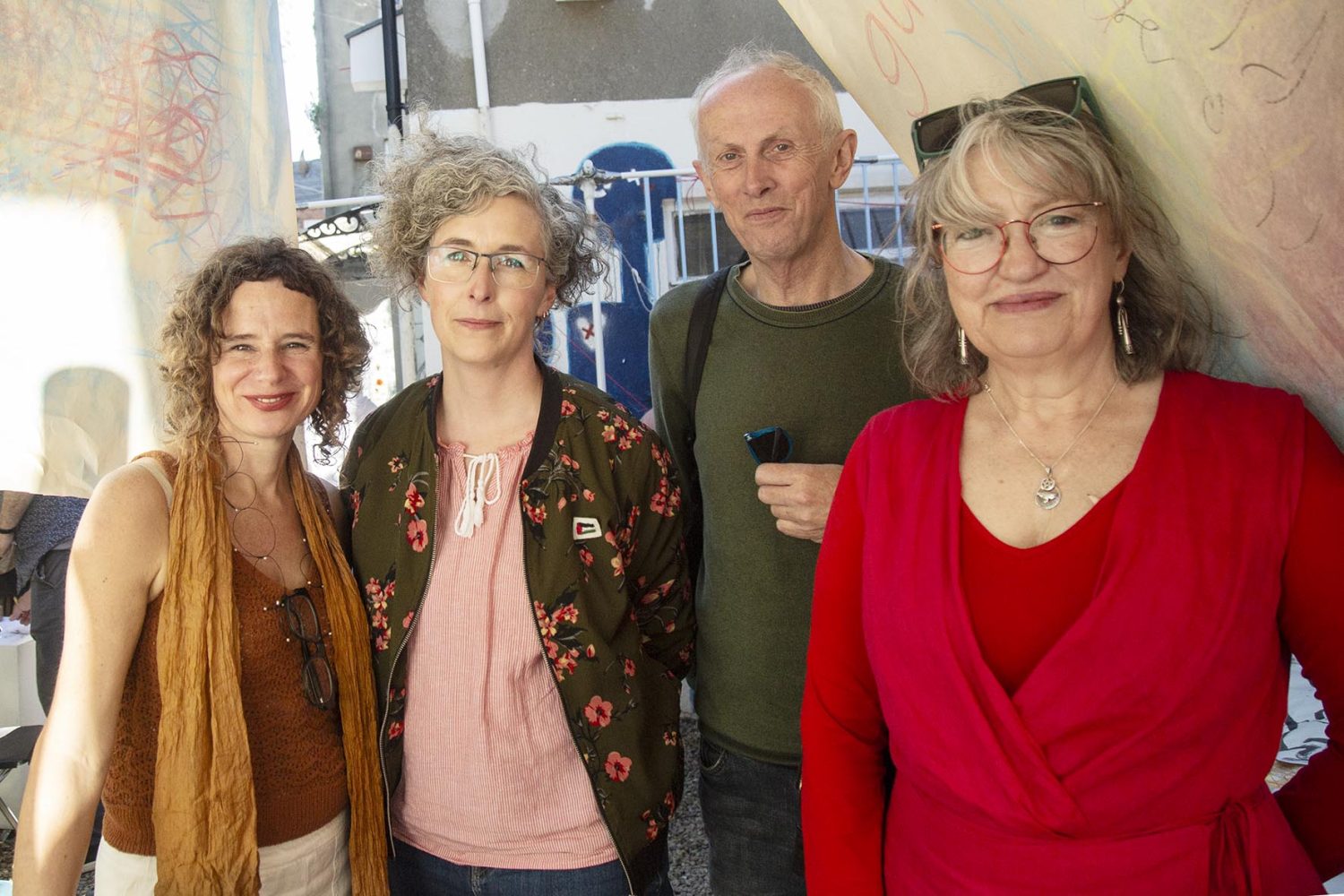
Last month I collaborated with Joanna Kidney and Philip St John AKA Wicklow Artists Salon to create an event called Salon Afoot. A glorious sunny Saturday in Bray, with the smell of candyfloss and gorse in the air. Silent reflective walking, loose collaborative creative responses, and time to play with materials, all culminating in smiling chats over pints at the Harbour Bar.
Many thanks to Joanna and Philip for asking me to do an event, and for exploring with me what a walking salon might be. And also to Eleanor Philips and all at Signal Arts Centre for hosting us so well and being open to our aim of offering the participants some mild, joyful chaos. Signal is a truly welcoming place.
This was the seventh in the series of structured group walk formats that I’ve been developing as an artistic practice over the past six years. You can read more about them here.
We might get strange looks, and that’s ok. It might feel unsettling for us to walk like this, and that’s ok too.
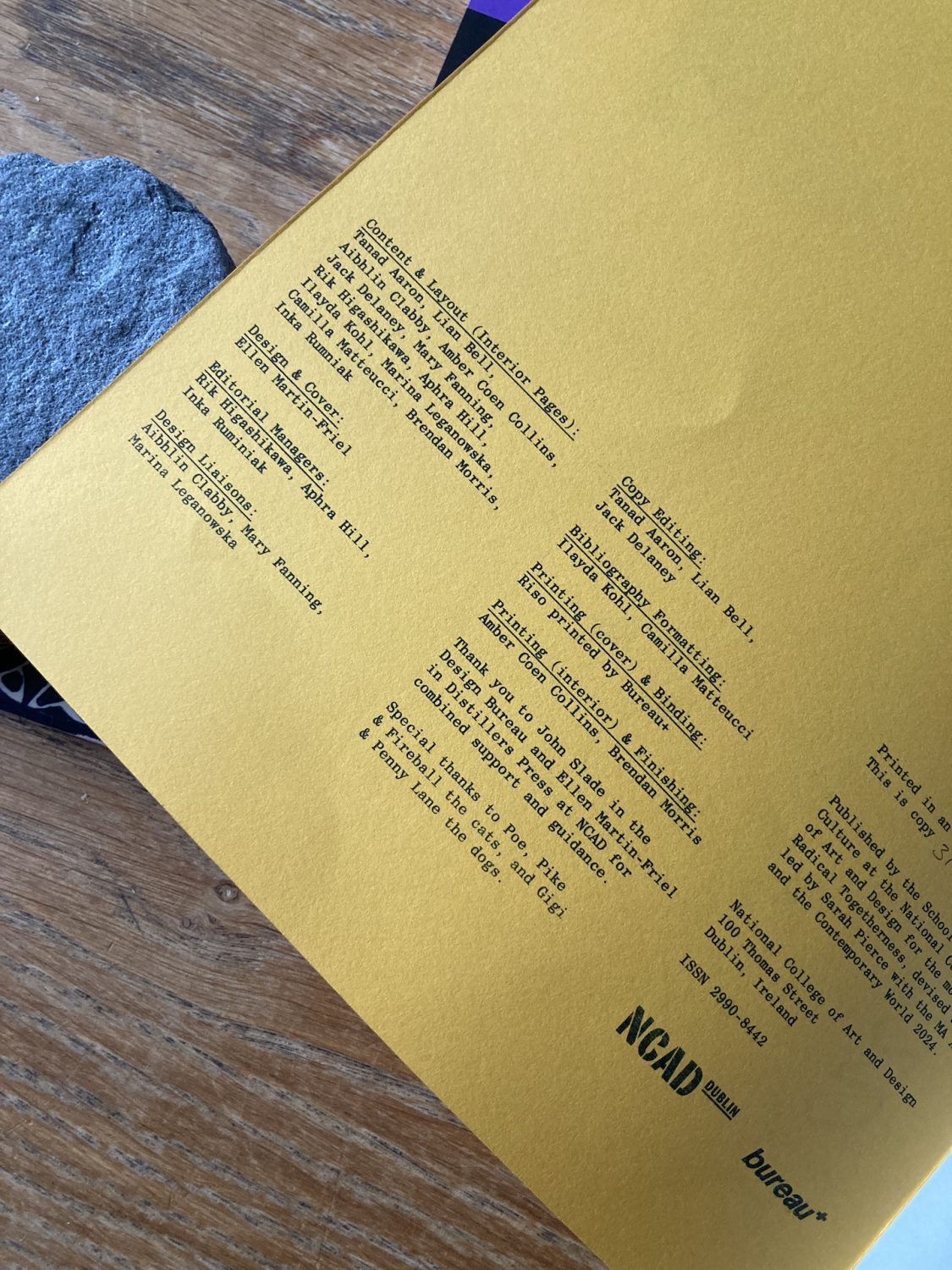
I’m part-way through studying for the MA/MFA Art in the Contemporary World at the National College of Art and Design. Last year our class made a collective publication; we each wrote texts, gathered notes on radical art collectives, designed our own pages, and shared the crediting. So if you read it you have to guess who wrote what. I wrote (giving the game away) something about obedience and the city, after finding out that the Latin motto for Dublin translates along the lines of: Obedient citizens make a happy city.
Radical Togetherness evolved out of a class led by artist Sarah Pierce, and the overall design and cover were by Ellen Martin-Friel. The publication was selected to be shown and sold at the Temple Bar Gallery + Studios annual Art Book Fair 2024, guest curated by Adrian Duncan to the theme Fictions: The makings of other worlds. We made a small profit which was donated to the Palestinian Children’s Relief Fund.
At the end of last year, I was surprised and pleased that a text I wrote was announced as a runner up in the Sarah Cecilia Harrison Essay Prize at the National Gallery of Ireland. The prize is sponsored by the family of the artist and suffragette to reward new research and writing about women in Ireland’s visual culture, as a way of re-vivifying stories that have faded. The family have committed to run it for ten years, and I hope that there are plans to make a book of the 30 or so selected pieces of writing at the end of it all. I’d definitely read it.
My surprise at being selected was partly because the text, called Doubles: a new archive, hovers on the edge of what could be called an essay. The writer and theatre maker Gina Moxley (also my friend and taker of the photo above) coined the term ‘messay’ to describe it. Doubles is partly about stained glass artist Wilhelmina Geddes and painter and champion of artists Sarah Purser. But it is also about tennis, friendship, 24 Pembroke Street Upper, the feel of materials in your hands, and the vertiginous overwhelm of archival research. In it, I conjure an speculative archive into being through the reading of a list of the contents of an imagined archive box. The archive is of the relationship between three pairs of women, living in different centuries and overlapping at a particular location.
I gave the text its first public outing at the Hugh Lane Gallery in late November, where I was asked to read it to the Sarah Purser Study Morning. The text is accompanied by an archive box of specially made glasswork made by my old friend Susan O’Connor. I am hopeful that the work will be published later this year.
“I’m doing this research as an ethical thing, but not just one to do with the pollution of aviation fuel. This journey is also about the ethics of deliberately going slower in an industry that increasingly values speed and productivity.”
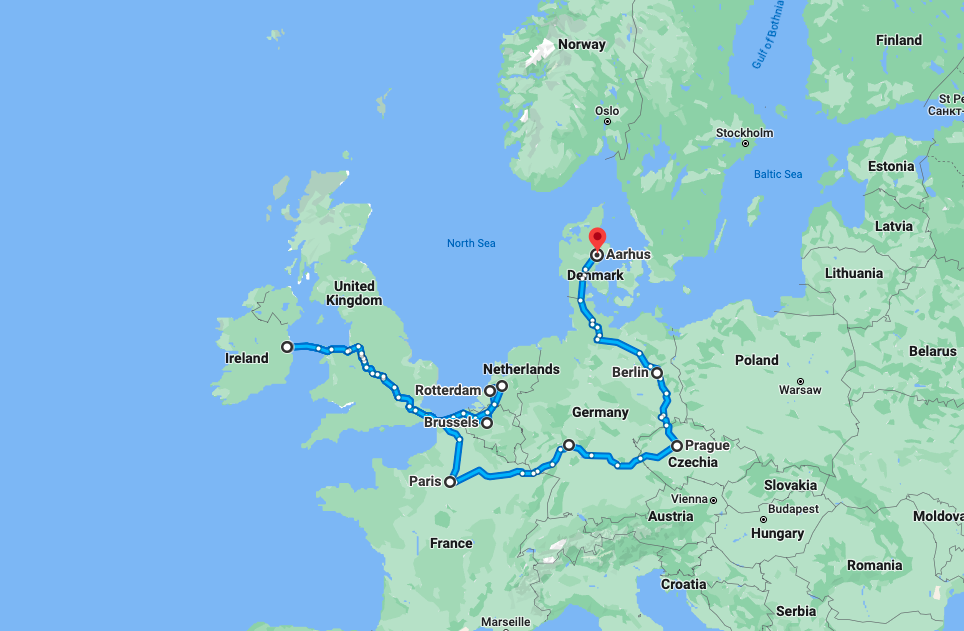
If you followed me on Instagram in 2023 you know I was testing out travelling around Europe for work using an Interrail pass. This was thanks to an Agility Award from the Arts Council of Ireland.
…
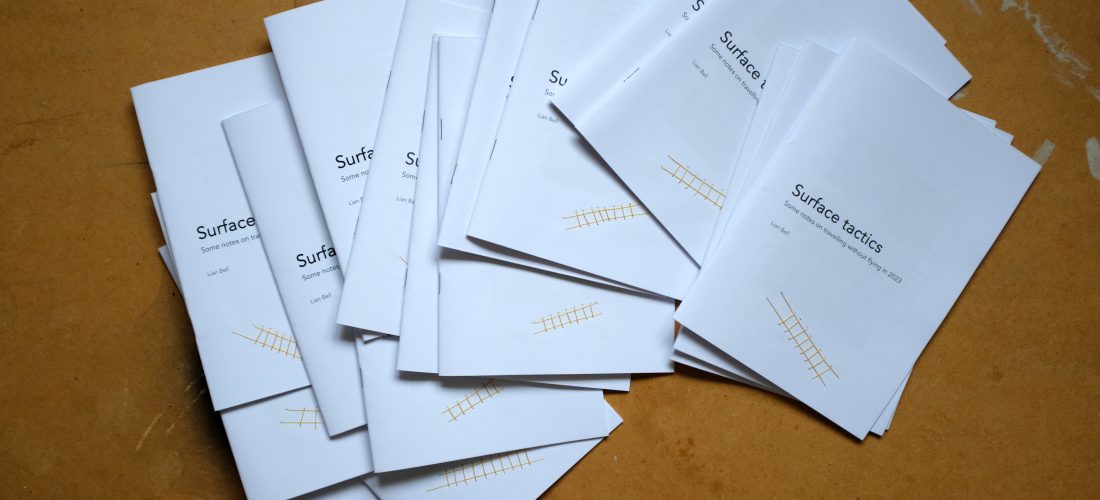
I’ve written an illustrated essay about my thoughts called Surface tactics. I’ve printed and sewn on a limited edition of 20 copies that were distributed to those who helped me along the way. If you’d like to read the text
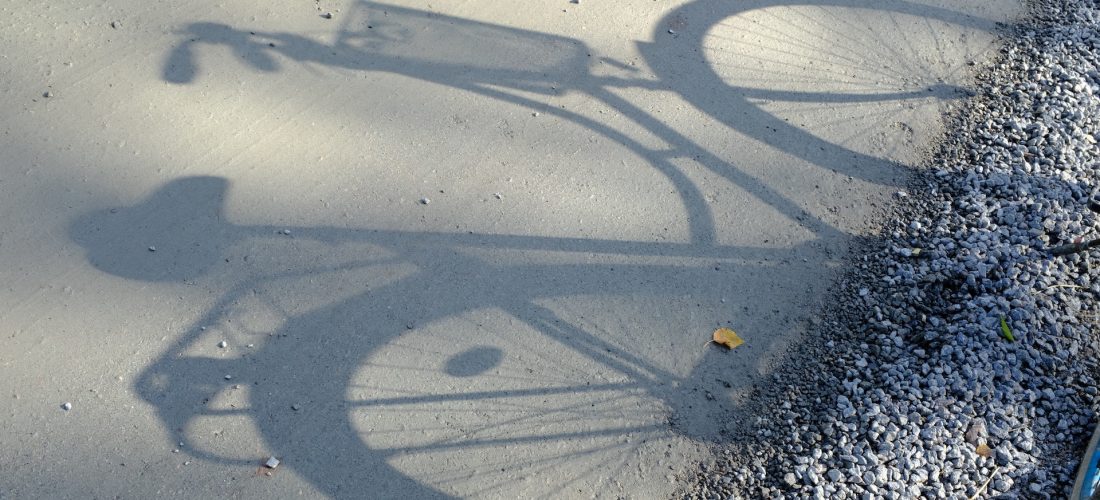
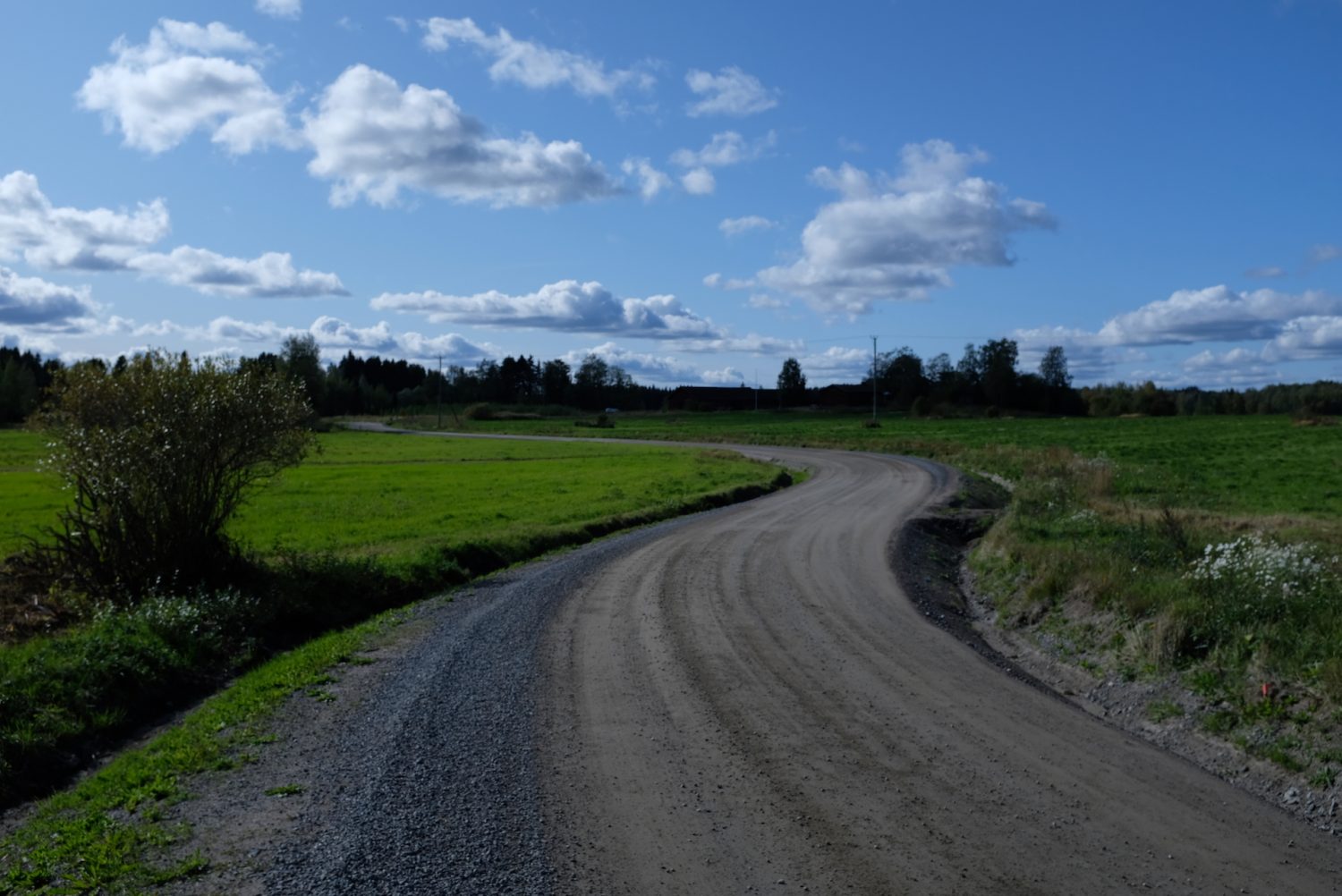
While on residency in Arteles Creative Centre in Finland last September I got to know the quiet dirt roads of the area by bike. The bikes available at the centre had no gears and only back pedal breaks, which made stopping on gravel surfaces challenging, and the rare downhill swoops felt specially daredevilish. The bikes had upright black frames and made me, in my black coat and jeans, feel like an Edward Gorey character pedalling through the open farmland surrounding the centre.
Cycling was a way to explore, and a chance to get some air
after long days spent in my workroom. Having no gears meant I was forced to
decelerate from the speeds I usually cycle in Dublin’s city centre. At first it
felt hugely frustrating. I couldn’t get anywhere in a hurry. I waved at the few
people and cars that I passed, and usually got a wary side-eye.
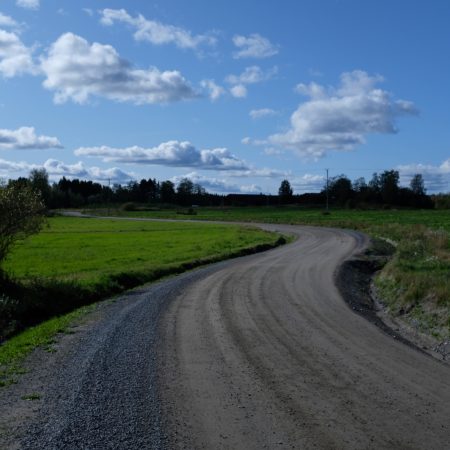
On those wide open flat landscapes you can watch the weather coming. I often found myself frantically pedalling to get to some kind of shelter – a bus stop, or a particularly lush tree – while heavy bluegrey rainclouds swooped at me over the open farmland. Another challenge was the pockmarked surface of the dirt roads themselves, with copious potholes from, I’m guessing, the harsh winters. Those bikes were not made for swerving, especially on gravel.
Over the weeks, thanks to the residency’s policy of no
phones and limited internet access, I settled into the luxury of living at a
more tranquil pace. I became happier with my slow cycling. I stopped trying to
get anywhere, and started to just explore all the little back roads and woods
nearby.
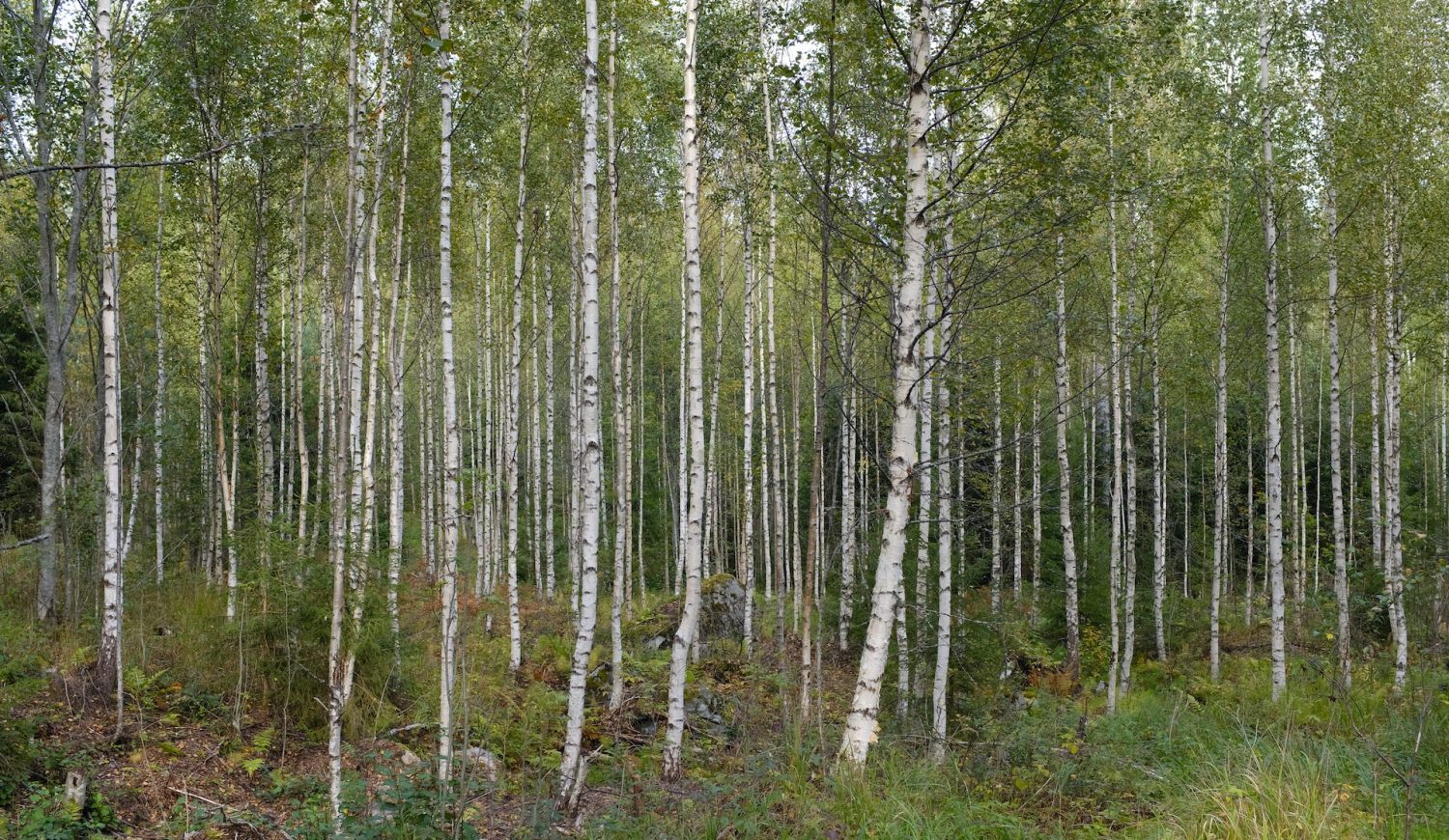
From my first days in Finland, I’d noticed many rowan trees
laden with their distinctive red berries among all the silver birch. Irish and
Finnish flora seems to have quite a lot in common – between the red rowans and
the browning bracken, I felt at home.
Since my automatic impulse to find out more by tapping
‘rowan’ into a computer wasn’t available to me, I enjoyed my ignorance and
settled with mentally saluting each rowan I passed on my slow bike.
Cycling back to Arteles one day during my last week there, I
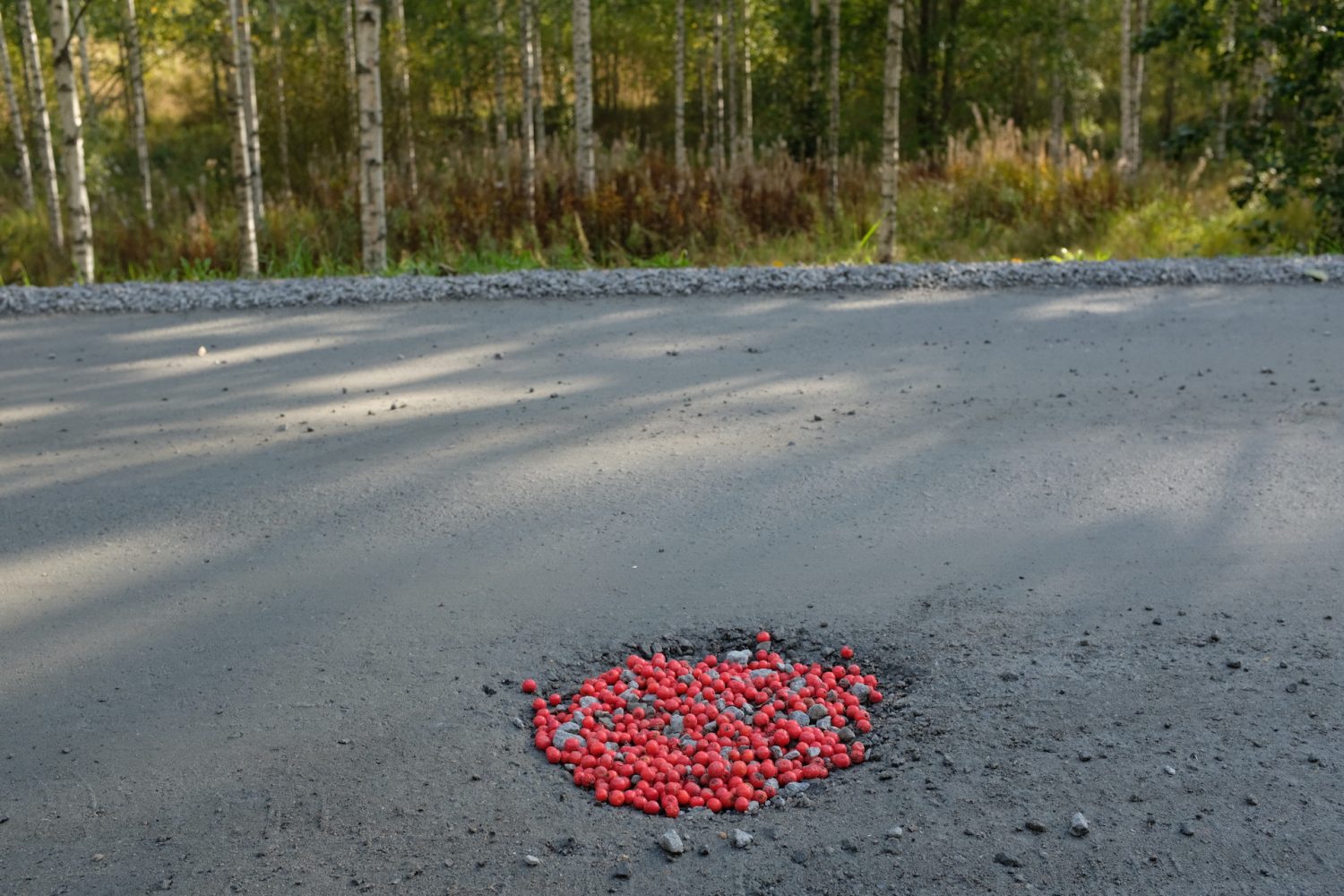
wove in and out of the gravelly potholes and imagined filling the holes in the
road as a thank you to the centre, to the people living around it – knowing
that even if I did the coming frozen winter would reopen those holes, or create
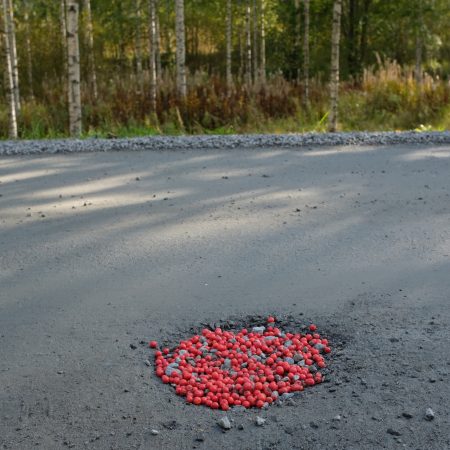
new ones, or both. I began to imagine filling the holes with rowan berries
instead – to make something beautiful and surprising for the people passing,
and also to celebrate the futility of my trying to actually repair their road.
But by the time I’d had this idea, the majority of the rowan berries were already shrivelled or gone – the short autumn was already giving way to frost. I only managed to collect enough berries to test out one pothole, so when I left, I left instructions for next year’s harvest.
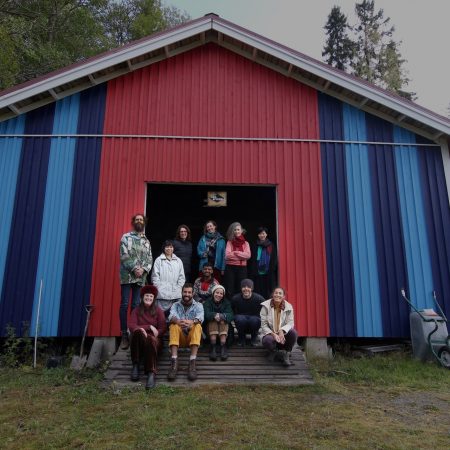
In September 2019 I was accepted on a month-long residency at Arteles Creative Centre in rural Finland. It was a magical time, that in retrospect has changed my life in a quiet way.
Photo by Ida Mantere
Photo by Mapi Rivera
My stay at Arteles felt like it might be a stepping off point, but I don’t know yet where I’m stepping off to. I don’t usually make work on my own, so this was a challenge and an opportunity for me to see what kind of things emerged from myself alone. (The next challenge for me is to work out what to do with some of these thoughts and potential projects. What form they take, and where/how I can show them. That’s the hard part…)
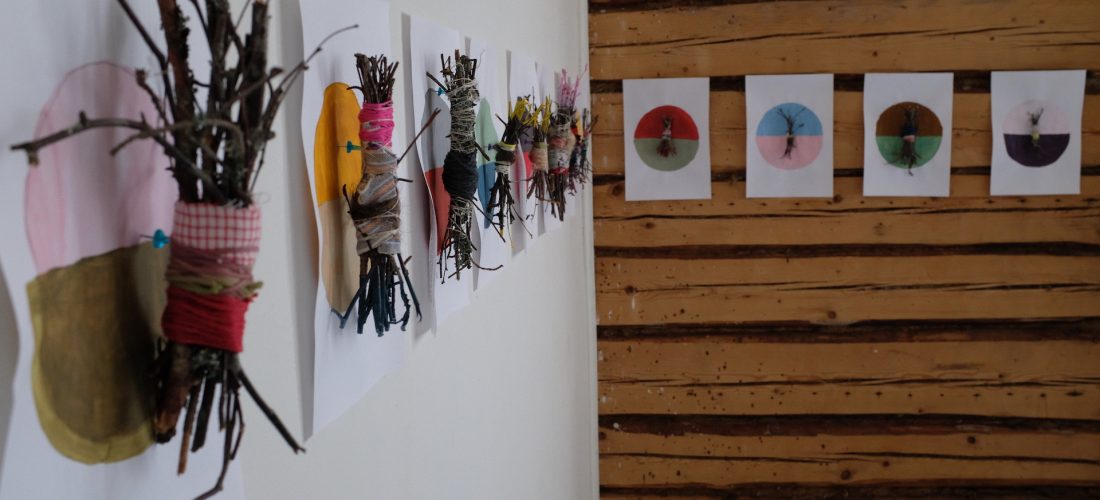
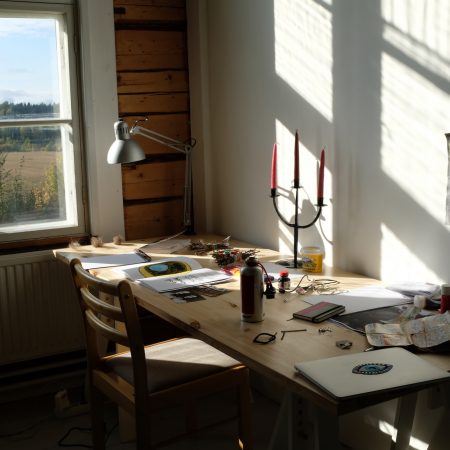
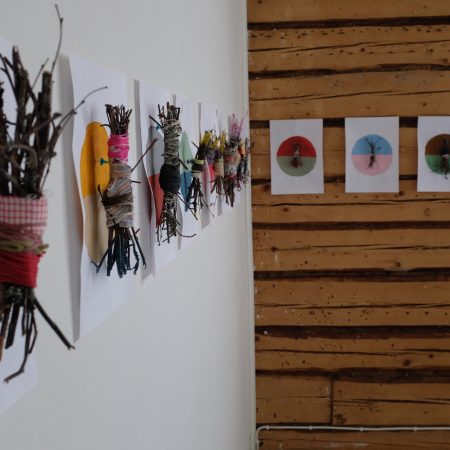
I came with no specific project in mind and tried to listen hard and follow interesting thoughts as they appeared. I took photographs, I came across unexpected new friends, I made things with my hands and gave them away, I wrote things and kept them to myself, I drew things and burned the drawings, I cycled very slowly and waved at passing cars.
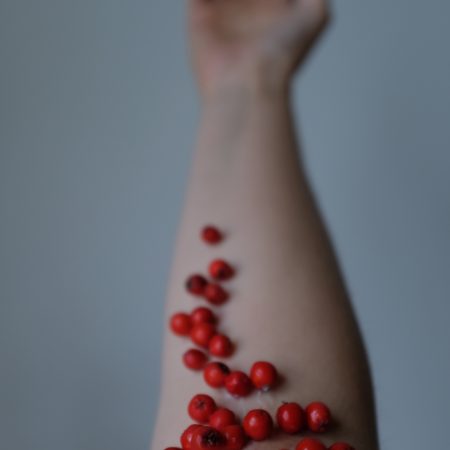
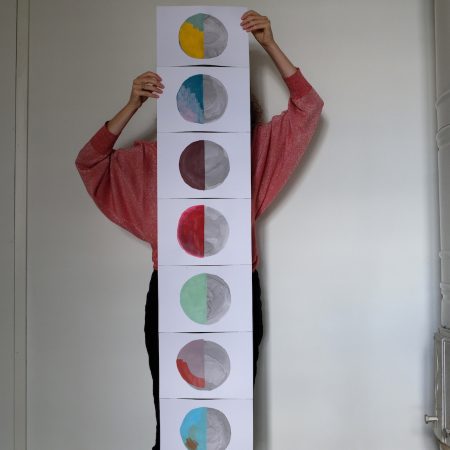
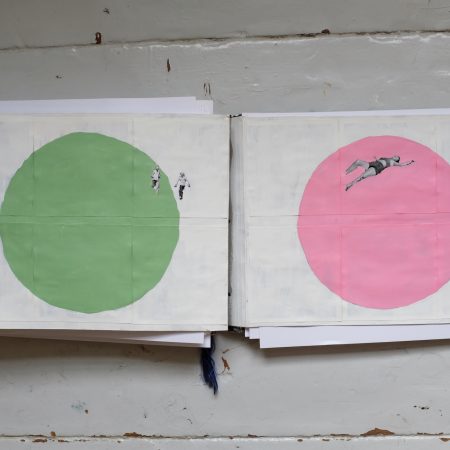
I thought a lot about hospitality, about obligation, about misremembered colours, about hugs, about being happily lost in translation, about rowan trees, about things in pairs. I tried to think about my brain from the inside. I tried to recalibrate how I think about the body that carries that brain around. I tried not to think about what to do with all these thoughts.
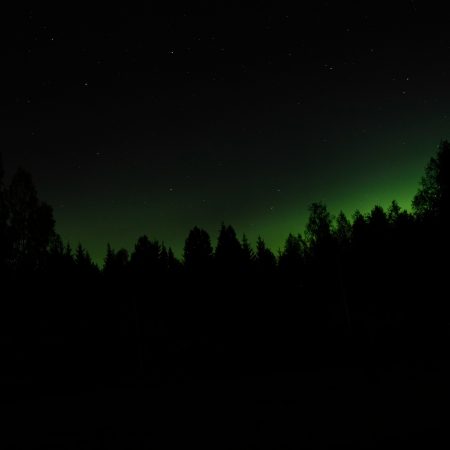
For the month we had no phones and limited internet, and being removed from the world was pure pleasure. It felt good to be among people who were always fully present. It felt good to be warmed through by the sauna. I was happily selfish and missed no one. I stopped reading the news, and haven’t started again. I ate too much smoked salmon. I saw the northern lights.
Being introduced to meditation and starting a daily practice gave me something new that I’ve taken into my Dublin life. The beautiful land, the changing clouds, and the little gravel roads around Haukijärvi are still in my thoughts every day. I’m very grateful for the lessons in how to be still and quiet and present.
After I came back I found it difficult to explain what I’d been up to for the four weeks. A friend said to me – you basically let yourself be an artist for a month. And he’s right, I did.